Help
Filter for PyCantus is a web API that facilitates working with the filtration component of the pycantus
library — a library for working with data on Gregorian chant.
This API provides an interface that allows users to prepare their filtration setup using a form, that also provides a list of potential values for individual fields based on the CantusCorpus v1.0 dataset. Once the selection is complete, simply click on the "Submit setting to generate filtration file" button and then download the YAML file describing the filter settings, which can then be loaded by the pycantus library.
If no value is entered in any of the fields, this is subsequently evaluated as "I don't care" and records with any value (even with such field being empty for the record) in the given field are considered.
Below is a description of the individual fields that correspond to the data model in the pycantus library and that can be used to filter data, including sample values and links to other sources.
If you are new to Gregorian chant and its data, we strongly recommend reading through introductory manuals completed for Cantus Database.
This API provides an interface that allows users to prepare their filtration setup using a form, that also provides a list of potential values for individual fields based on the CantusCorpus v1.0 dataset. Once the selection is complete, simply click on the "Submit setting to generate filtration file" button and then download the YAML file describing the filter settings, which can then be loaded by the pycantus library.
If no value is entered in any of the fields, this is subsequently evaluated as "I don't care" and records with any value (even with such field being empty for the record) in the given field are considered.
Below is a description of the individual fields that correspond to the data model in the pycantus library and that can be used to filter data, including sample values and links to other sources.
If you are new to Gregorian chant and its data, we strongly recommend reading through introductory manuals completed for Cantus Database.
Fields
Chants
Following first three fields are reflecting directly what is usualy writen in the medieval source itself.
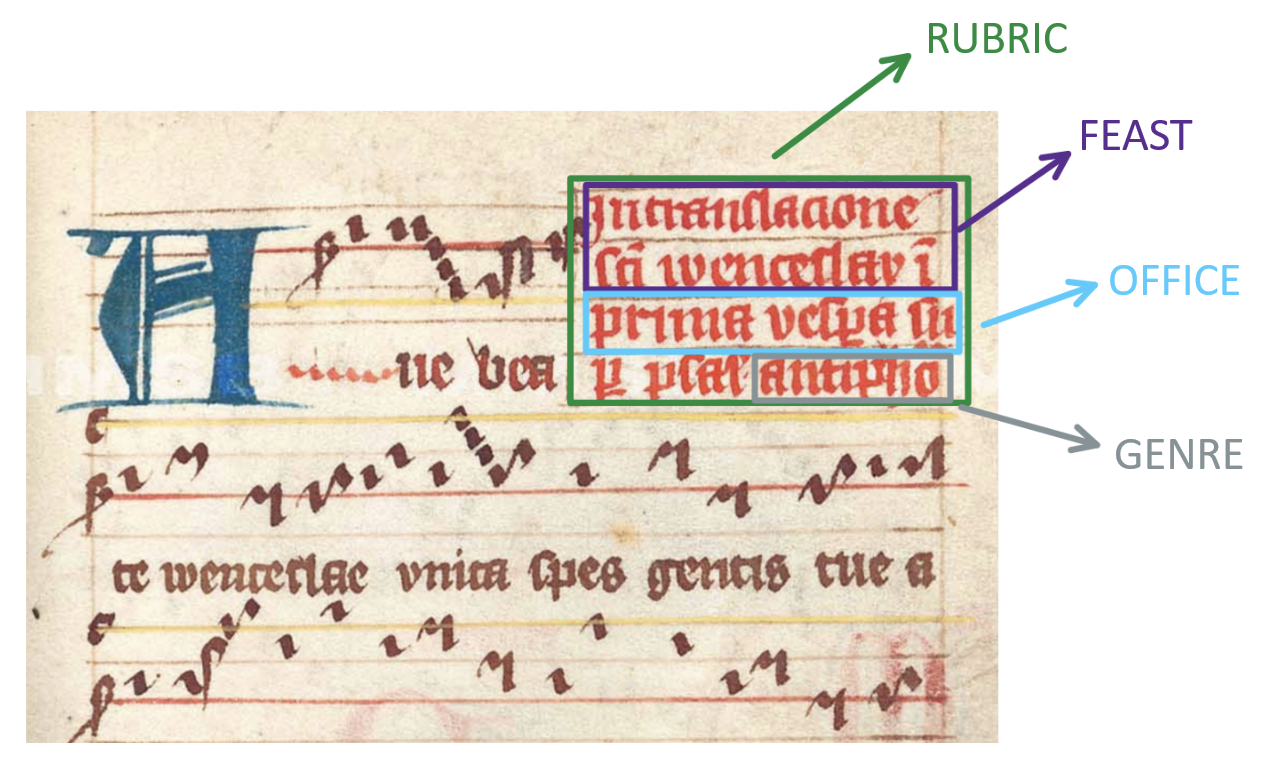
Rubric in medieval liturgical manuscript with description of each part.
And here we present schema on Cantus Index ecosystem that is here used to provide wider image on the "old book" -> "web database" path of the data.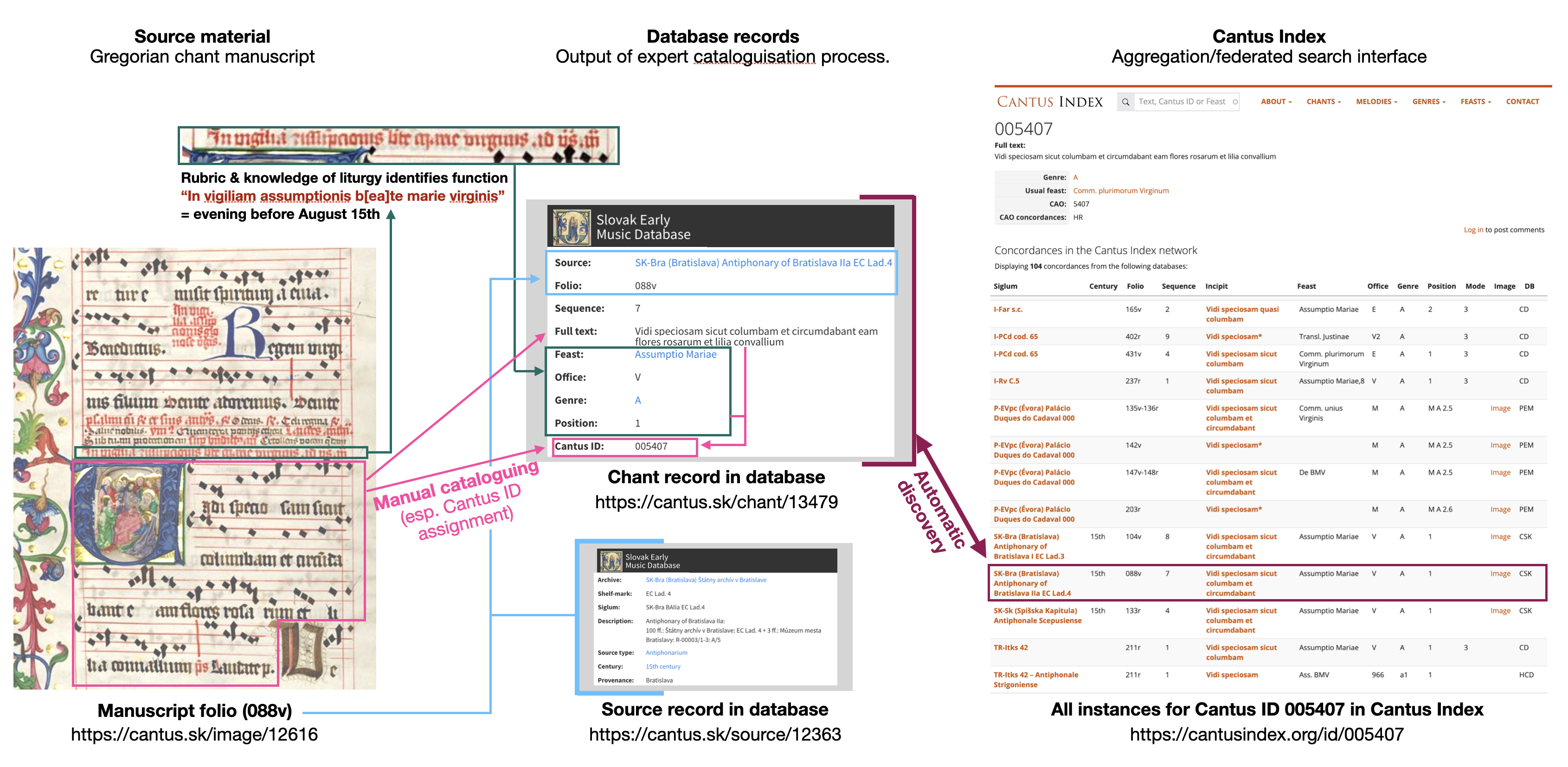
Chant data in the Cantus ecosystem. An expert reads a manuscript (today most often digitised), identifies individual instances of chants, and creates their database records: most importantly, assigning the Cantus ID to identify which unit of chant repertoire is on the page (pink process). Expertise in the liturgy of the Latin church is needed, as one must correctly interpret abbreviated notes in the manuscript --- rubrics --- in order to identify the liturgical position and function of the chant (dark green process); together with the text of the chant, this then allows one to assign the correct Cantus ID. A link to the source and page (folio) within the source is added (blue process). Once a record with a Cantus ID is added to a database in the Cantus ecosystem, the Cantus Index hub will retrieve the record, primarily via a search for all instances of the given Cantus ID across all databases that are registered with Cantus Index (purple process; automatic).
Rubric in medieval liturgical manuscript with description of each part.
And here we present schema on Cantus Index ecosystem that is here used to provide wider image on the "old book" -> "web database" path of the data.
Chant data in the Cantus ecosystem. An expert reads a manuscript (today most often digitised), identifies individual instances of chants, and creates their database records: most importantly, assigning the Cantus ID to identify which unit of chant repertoire is on the page (pink process). Expertise in the liturgy of the Latin church is needed, as one must correctly interpret abbreviated notes in the manuscript --- rubrics --- in order to identify the liturgical position and function of the chant (dark green process); together with the text of the chant, this then allows one to assign the correct Cantus ID. A link to the source and page (folio) within the source is added (blue process). Once a record with a Cantus ID is added to a database in the Cantus ecosystem, the Cantus Index hub will retrieve the record, primarily via a search for all instances of the given Cantus ID across all databases that are registered with Cantus Index (purple process; automatic).
Genre
Individual songs can be divided into two larger categories according to style, which are further
divided into more specific genres. These are liturgical recitative and free
composition. This division is based on an effort to find a balance between the comprehensibility
of the sung text and the beauty and richness of the musical component.
The basic feature of liturgical recitative is the singing of the text on a single tone, with the ends of sentences and other sections emphasized by a slight rise or fall in the melody. This technique can be used for any text of any length. It is commonly used in prayers and readings, i.e., texts that change almost every day of the year.
Psalmody, the method of performing psalm texts, constitutes a specific intermediate stage. Because these are texts recited with freely composed chants in close proximity (antiphons or responsories), the recitation formulas have been perfected. In addition, there are a limited number of psalms, and they are all used during each week.
In contrast, it is typical for free composition that each text has its own melody of varying complexity. As mentioned above, these are mainly antiphons (which form the boundaries of the psalms) and responsories (which often delimit the readings - lessons), followed by hymns (songs with a strophic structure) and invitatories (songs opening the night prayers of the office). After the early Middle Ages, sequences and tropes (more free and varied genres) were added.
The Mass was expanded to include genres corresponding to its parts (e. g. Alleluia, Credo or Gloria).
Here is an overview of main genres of Office of Hours:
List of genres used in Cantus Index can be found here.
For more detailed info refer to some of the Cantus Database Instructional Documents or to literature such as Harper, John. The Forms and Orders of Western Liturgy from the Tenth to the Eighteenth Century: A Historical Introduction and Guide for Students and Musicians. Oxford: Clarendon Paperbacks, 1991 or Hughes, Andrew. Medieval Manuscripts for Mass and Office. A Guide to their Organization and Terminology. Toronto; Buffalo; London: University of Toronto Press, 1982.
The basic feature of liturgical recitative is the singing of the text on a single tone, with the ends of sentences and other sections emphasized by a slight rise or fall in the melody. This technique can be used for any text of any length. It is commonly used in prayers and readings, i.e., texts that change almost every day of the year.
Psalmody, the method of performing psalm texts, constitutes a specific intermediate stage. Because these are texts recited with freely composed chants in close proximity (antiphons or responsories), the recitation formulas have been perfected. In addition, there are a limited number of psalms, and they are all used during each week.
In contrast, it is typical for free composition that each text has its own melody of varying complexity. As mentioned above, these are mainly antiphons (which form the boundaries of the psalms) and responsories (which often delimit the readings - lessons), followed by hymns (songs with a strophic structure) and invitatories (songs opening the night prayers of the office). After the early Middle Ages, sequences and tropes (more free and varied genres) were added.
The Mass was expanded to include genres corresponding to its parts (e. g. Alleluia, Credo or Gloria).
Here is an overview of main genres of Office of Hours:
| Genre | Abbreviation | Description |
|---|---|---|
| Antiphons | A | Short, tuneful chants that precede psalms and canticles |
| Invitatory antiphon | I | An antiphon sung in alternation between verses of Psalm 94, Venite exsultemus at beginning of Matins. |
| Responsory | R | Ornate chant with two primary parts: Respond and Verse. R in database refers to Respond. Often sung in response to a Lesson (longer reading). |
| Hymns | H | Poetic texts with multiple stanzas (strophic,tuneful chants) |
| Responsory verse | V | Verse that completes a responsory together with Respond |
| Versicle | W | Short sung sentences followed by a short sung Response |
| Canticle | Ca | Poetic texts from the New Testament, usually the Benedictus and Magnificat, sung to psalm tones. |
| Psalm | Ps (PS) | Poetic texts from the Old Testament sung to psalm notes |
List of genres used in Cantus Index can be found here.
For more detailed info refer to some of the Cantus Database Instructional Documents or to literature such as Harper, John. The Forms and Orders of Western Liturgy from the Tenth to the Eighteenth Century: A Historical Introduction and Guide for Students and Musicians. Oxford: Clarendon Paperbacks, 1991 or Hughes, Andrew. Medieval Manuscripts for Mass and Office. A Guide to their Organization and Terminology. Toronto; Buffalo; London: University of Toronto Press, 1982.
Office
Office brings answer to the question "What time shloud we sing this?" giving each chant time slot in the day
of medieval community.
Daily cycle of the Office with indicated Mass (after Hiley, 2009):
Structure of each of the offices/services slightly varies, for example Lauds and Vespers have the following order:
Daily cycle of the Office with indicated Mass (after Hiley, 2009):
| Latin | English | Abbreviation | Time of Day |
|---|---|---|---|
| Ad vesperam | Vespers | V | before sunset |
| Ad completorium | Compline | C | before rest |
| Ad Matutinum | Matins | M | at night, before Lauds (after midnight) |
| Ad Laudes | Lauds | L | before down, after Matins |
| Ad primam | Prime | P | at dawn |
| Missa matutinalis | Morning Mass | MI or MASS | (in winter after Terce) |
| Ad tertiam | Terce | T | at nine |
| MISSA | Mass | MI or MASS | (in winter after Sext) |
| Ad sextam | Sext | S | at noon |
| Ad nones | None | N | at three |
| On great feastsa | |||
| Ad vesperam II | Second Vespers | V2 | |
| Ad completorium | Compline | C | |
a On days of special significance, on the eve of the following day instead of the usual Vespers, Second Vespers are sung, relating to that feast.
Structure of each of the offices/services slightly varies, for example Lauds and Vespers have the following order:
| Chants | Details |
|---|---|
| Opening versicles | |
| Antiphons with 5 psalms | Each antiphon is sung twice - before and after each psalm. |
| Chapter | Short reading |
| Hymn | |
| Versicle and response | Short sung sentences followed by a short sung Response |
| Lauds: Antiphon and Benedictus | Canticle |
| Vespers: Antiphon and Magnificat | Canticle |
| Collect and Benedicamus domino |
Feast
The field “feast” indicates for which liturgical event the chant was prescribed/intended.
It is often writen directly in the source as part of rubrics (look above on examples).
E.g.: St. George or Dom. 1 Adventus
One feast can be encoded by two or more different terms based on source database annotation style.
Lists of feasts can be found e.g. on Cantus Index and LFRI websites.
E.g.: St. George or Dom. 1 Adventus
One feast can be encoded by two or more different terms based on source database annotation style.
Lists of feasts can be found e.g. on Cantus Index and LFRI websites.
Source database
Abbreviation of database from Cantus Index network where chant records are comming from.
Cantus Index databases that can be found in data from CantusCorpus v1.0 are:
Cantus Index databases that can be found in data from CantusCorpus v1.0 are:
| Name | Abbreviation | Link |
|---|---|---|
| Cantus Database | CD | https://cantusdatabase.org/ |
| Medieval Music Manuscripts Online | MMMO | https://musmed.eu/ |
| Slovak Early Music Database | CSK | https://cantus.sk/ |
| Cantus Fontes Bohemiae | FCB | https://cantusbohemiae.cz/ |
| Cantus Planus in Polonia | CPL | https://cantusplanus.pl/ |
| Portuguese Early Music Database | PEM | https://pemdatabase.eu/ |
| Spanish Early Music Manuscripts Database | SEMM | https://musicahispanica.eu/ |
| Hungarian Chant Database | HCD | https://hun-chant.eu/ |
| Medieval Music Manuscripts from Austrian Monasteries | A4M | https://austriamanus.org/ |
| Codicologica et Hymnologica Bohemica Liturgica | HYM | https://hymnologica.cz/ |
Sources
Title
Textual identificator of the source, can be same as siglum or possibly some traditional name.
E.g.: A-KN CCl 00063 Antiphonarium or Jistebnice Gradueale / Jistebnický graduál
E.g.: A-KN CCl 00063 Antiphonarium or Jistebnice Gradueale / Jistebnický graduál
Siglum
Identificator of the source (mostly RISM style, but can be different).
E.g.: A-Gu Ms 0807 or CDN-Mrb MS Medieval 0222
E.g.: A-Gu Ms 0807 or CDN-Mrb MS Medieval 0222
Century
Text representation of the century of origin (taken directly from database containing that source record).
E.g.: 12th century (2nd quarter) or c. 1200
E.g.: 12th century (2nd quarter) or c. 1200
Numerical Century
Cenury of origin represented as single integer number.
E.g.: value 12 for 12th century as well as for 1155 or 1st half of 12th
E.g.: value 12 for 12th century as well as for 1155 or 1st half of 12th
Provenance
Provenance means "where is the source (book) from".
Different levels of granularity are used.
E.g.: St. George monastery in Prague or Spain
Different levels of granularity are used.
E.g.: St. George monastery in Prague or Spain
Cursus
Cursus indicates the origin/place of use of the source in terms of institution.
E.g.: secular cursus (meaning it was used in other institutions than monasteries, e.g. cathedrals) or monastic cursus (for sources comming from monasteries)
E.g.: secular cursus (meaning it was used in other institutions than monasteries, e.g. cathedrals) or monastic cursus (for sources comming from monasteries)